
A small bedroom can become frustrating surprisingly quickly. A few clothes on a chair, shoes near the door, extra bedding on the floor, and suddenly the room feels much smaller than it actually is.
The good news is that you do not always need a bigger wardrobe or another large piece of furniture. The most effective storage tips for small bedrooms are about using forgotten space, choosing storage according to what you own, and keeping the things you use most within easy reach.
Before buying anything, take a look at how your bedroom is actually being used. You may already have more storage space than you think.
Start With What You Actually Need to Store
A common mistake is buying storage before deciding what actually needs to go inside it. Take everything that is currently creating clutter and divide it into three simple groups:
- Things you use often: everyday clothes, bags, books, chargers, accessories, and other items you reach for regularly.
- Things you use sometimes: seasonal clothes, spare bedding, luggage, special occasion clothing, and similar items.
- Things you rarely use: belongings that you want to keep but hardly ever need.
Now match the storage to the frequency of use. Everyday items should be the easiest to reach. Seasonal and occasional belongings can go higher up, under the bed, or toward the back of a wardrobe. This small change can make a bedroom feel much more organized without adding any furniture.
Look for Storage Space You Are Already Ignoring
Walk around your bedroom and look at the empty areas rather than the furniture. There may be unused space under the bed, above a desk, behind the bedroom door, beside a wardrobe, or above an existing cabinet. These areas are often more useful than they first appear. For example a narrow wall shelf may be enough for books and small personal items. A few hooks can handle bags and accessories. A suitable container under the bed can take care of seasonal clothes or spare bedding. The important thing is to solve a specific storage problem instead of filling every empty space just because it is available.
Measure Before Buying Anything
This sounds obvious, but it can save you from one of the most annoying small bedroom problems: buying furniture that technically fits but makes the room uncomfortable.
Measure the width, height, and depth of the area where you want to put the storage. Then check what happens when the furniture is actually being used.
Can the wardrobe door open fully?
Can you walk comfortably around the bed?
Can drawers open without hitting another piece of furniture?
Can you still reach the window or radiator if there is one?
A few minutes with a tape measure can tell you more than a product photo ever will.
Use the Space Under Your Bed Properly
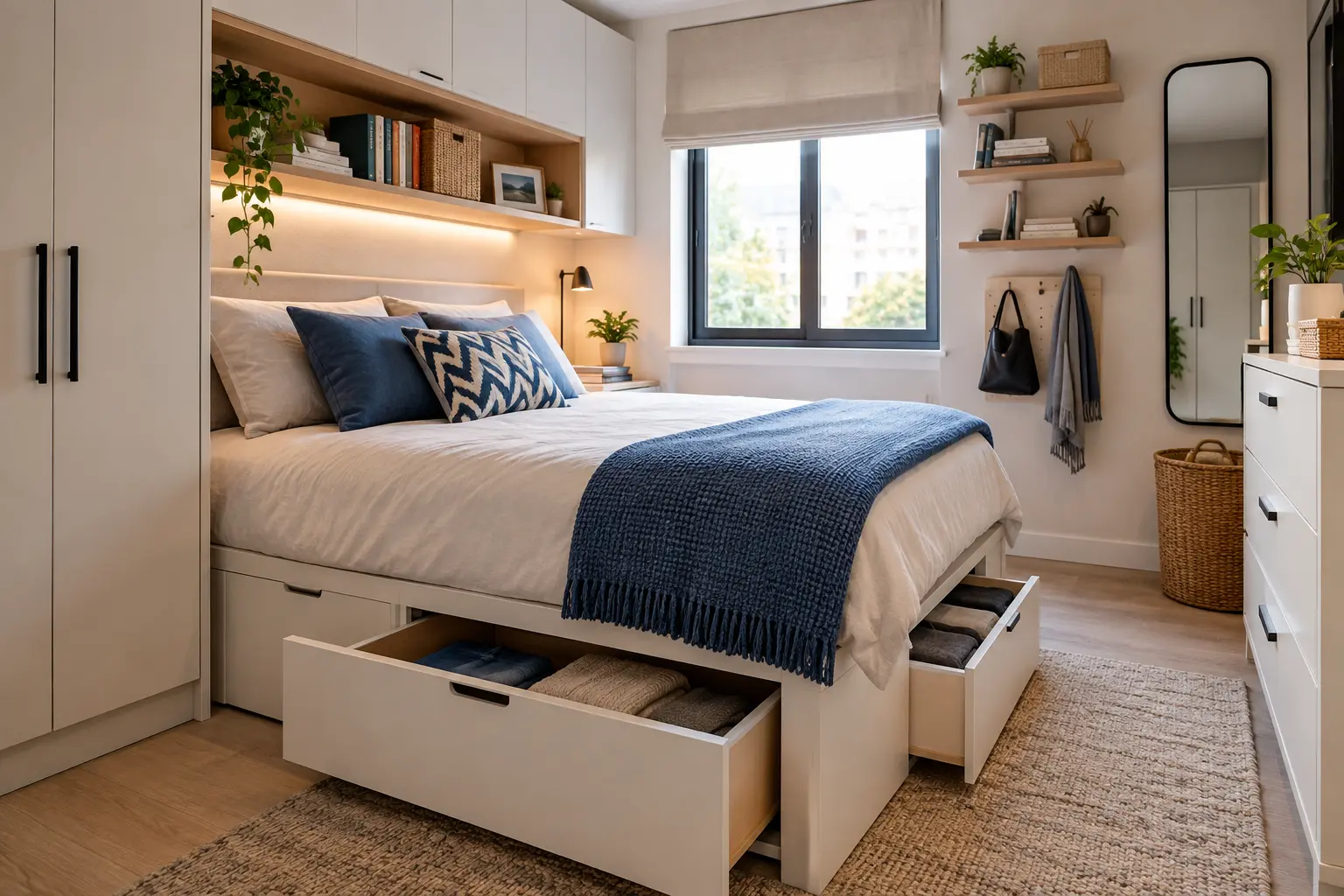
The space beneath a bed is one of the easiest places to add storage without taking up additional floor area. It works particularly well for things you do not need every day, such as seasonal clothing, spare bedding, shoes, or luggage accessories.
Try not to turn it into a place where random belongings disappear. Give each box or container a purpose.
For example, one container could be for winter clothing and another for spare bedding. If the containers are opaque, a simple label can save you from opening several boxes just to find one item.
If your bed is low to the floor, shallow containers may be a better option than trying to force large boxes underneath it.
Make Better Use of Vertical Space
Small bedrooms often have more unused wall height than unused floor space. That makes vertical storage particularly useful.
A tall shelving unit can use space that would otherwise be wasted. Wall mounted shelves can hold books, small baskets, or decorative items. Hooks can keep bags, hats, and accessories off chairs and floors.
But there is a balance.
If every wall is covered with shelves and objects, the room can start feeling visually crowded even if the floor is tidy. Use vertical storage where it solves a real problem and leave some wall space clear.
Choose Bedroom Storage Cabinets for the Room, Not Just the Capacity
When choosing bedroom storage cabinets, it is tempting to pick the largest one that fits. In a small bedroom, that is not always the smartest choice.
A cabinet that is slightly narrower or shallower may leave you with a much better walkway. You may lose some internal storage but gain a room that is easier to use every day. Think about the shape of the room as well as the amount of storage you need.
If you are unsure whether a cabinet is too large, mark its approximate footprint on the floor using removable tape. Walk around it and imagine opening the doors or drawers. That simple test can reveal problems before you spend any money.
Create a Home for the Things That Cause Most Clutter
Look at what normally ends up on your chair, floor, desk, or bed. Those items are telling you where your storage system is failing. If bags always end up beside the door, create a place for bags near the entrance.
If clothes regularly end up on a chair, check whether your wardrobe is difficult to access or whether you need a more convenient place for clothes that are not ready for the laundry.
If books keep piling up beside the bed, a small shelf or bedside storage may be more useful than another large cabinet.
Instead of asking, “Where can I put more storage?” ask, “Why does this item keep ending up
here?”
That question often leads to a much better solution.
Do Not Waste the Back of the Door
The back of the bedroom door can be useful for lightweight items.
Depending on the door and available clearance, you might use hooks or an over door organizer for accessories, bags, shoes, or other small belongings.
Just make sure the added storage does not stop the door from opening properly or hit nearby furniture.
This is a good example of the difference between unused space and usable space. An area is only valuable if using it does not create another problem.
Give High Storage to Low Frequency Items
The easiest storage locations should go to the things you use most. This is one of the simplest rules for maintaining an organized small bedroom.
Keep everyday clothes at a comfortable height. Put seasonal clothing on higher shelves when it is out of season. Store spare bedding somewhere accessible but not necessarily at eye level.
If you put your most frequently used belongings in awkward locations, you are more likely to leave them outside the storage when you are in a hurry.
Good organization should make the right behaviour easier.
Consider Multi Purpose Furniture
When floor space is limited, furniture that performs two jobs can be especially useful.
A bed with drawers can provide both sleeping space and clothing or bedding storage. A storage ottoman can provide seating and a place for blankets. A bedside table with drawers can keep smaller belongings contained instead of spreading them across the room.
You do not need every piece of furniture to have built in storage. Even replacing one bulky item with a more practical alternative can make a noticeable difference.
Keep Some Empty Space
This is an easy point to overlook. You do not need to use every available centimetre of a small bedroom.
Leaving some empty floor and wall space makes it easier to move around, clean, and visually understand the room. If storage has reached the point where you can barely walk around the bed, adding another organizer probably is not the answer.
Instead, look at what you already own and decide whether everything really needs to remain in
the bedroom.
Storage Does Not Have to Look Like Storage
A practical bedroom does not have to look like a row of boxes and cabinets. Baskets, attractive shelves, bedside furniture, fabric containers, and simple hooks can all become part of the room’s overall design.
If you are also working on the appearance of your bedroom, you may find our guide to Cool Room Ideas useful for combining organization with a more attractive room design.
The best result is usually a room where storage feels like part of the design rather than something added after the room was finished.
What If Your Existing Cabinets Are Not Working Well?
Sometimes the problem is not the amount of storage but the way the existing furniture works.
A cabinet door that does not close properly, for example, can make an otherwise useful cabinet frustrating to use. Before replacing furniture, check whether a small adjustment can solve the problem.
If your cabinet doors are sitting unevenly or not closing correctly, our guide on Adjusting Cabinet Hinges may help you understand what can be adjusted.
Small repairs can sometimes make existing storage much more useful.
Borrow Ideas From Other Rooms
Storage problems are not limited to bedrooms. A system that works well in a kitchen can sometimes inspire a better approach elsewhere. The basic idea is to divide belongings according to how they are used and make the frequently needed items easier to reach. For more ideas about making better use of limited space, see our guide to Kitchen Storage Ideas.
The exact products may be different, but the principle is the same: use the available space according to your routine instead of simply adding more containers
A Simple Way to Plan Your Bedroom Storage
If you are starting from scratch, use this order:
First, decide what actually needs to be stored.
Next, separate everyday belongings from occasional and seasonal items.
Then identify unused spaces in the bedroom.
After that, measure those spaces.
Finally, choose storage that solves the biggest problem without making the room harder to use.
This approach is usually better than walking into a shop, seeing a large storage unit, and trying to find a place for it afterward.
Frequently Asked Questions
What storage works best when I do not have space for another wardrobe?
Look at storage that uses space you already have rather than adding another large floor standing unit. Under bed containers, wall shelves, hooks, and narrow vertical storage can be useful depending on the room. If clothing is the main problem, improving the way the existing
wardrobe is organized may also free up more usable space.
How can I store seasonal clothes without making my bedroom feel crowded?
Keep seasonal clothing out of your most convenient storage areas when you are not using it. Suitable under bed containers, upper wardrobe shelves, or another dry storage area can work well. Store clothes clean and completely dry, and avoid packing them so tightly that they become difficult to remove.
Is open shelving a good idea for a small bedroom?
It can be, particularly for books and attractive everyday items. However, open shelves can make a room look busy if they become a place for miscellaneous belongings. If you tend to accumulate clutter, some closed storage may be easier to maintain.
How do I know if a storage cabinet is too deep for my bedroom?
Measure the cabinet depth and mark it on the floor before buying it. Then check the remaining walking space and make sure nearby doors and drawers can open properly. A cabinet with less internal capacity can sometimes be a better choice if it leaves the room easier to move around in.
What should I do when my bedroom has plenty of storage but still looks messy?
Look at the items that repeatedly end up outside the storage. The problem may be access rather than capacity. Move frequently used items to easier locations, group similar belongings together, and remove or relocate things that do not really need to live in the bedroom.
Final Thoughts
The best small bedroom storage system is not necessarily the one with the most shelves, boxes, or cabinets. It is the one that makes everyday life easier.
Start by paying attention to what causes clutter in your room. Give those items a convenient home, use overlooked spaces carefully, and choose furniture based on the actual dimensions of your bedroom.
Most importantly, do not be afraid to leave some space empty. A bedroom should still feel like a place to relax and sleep, not a storage room with a bed in it.
With a little planning, even a compact bedroom can have enough bedroom storage to stay practical, comfortable, and easy to maintain.