
Adjusting Cabinet Hinges: How to Align Cabinet Doors Properly
Cabinet doors that sit crooked, rub against each other, or refuse to close properly can make an otherwise neat kitchen or bathroom look unfinished. The good news is that many cabinet doors can be corrected with a screwdriver and a few small adjustments.
Adjusting cabinet hinges is mainly about changing the door’s position from side to side, up and down, or slightly forward and backward. Once you understand what each adjustment does, fixing uneven cabinet doors becomes much easier.
What Causes Cabinet Doors to Become Misaligned?
Cabinet doors can shift over time because of loose screws, repeated use, movement in the cabinet box, or hinges that have been installed slightly out of position. A door may also appear uneven after new cabinets, flooring, or other nearby work changes the way the cabinet sits.
Before adjusting anything, close the door slowly and look at the gaps around it. An uneven gap usually tells you which direction needs attention.
Adjusting Cabinet Hinges: How to Align Cabinet Doors
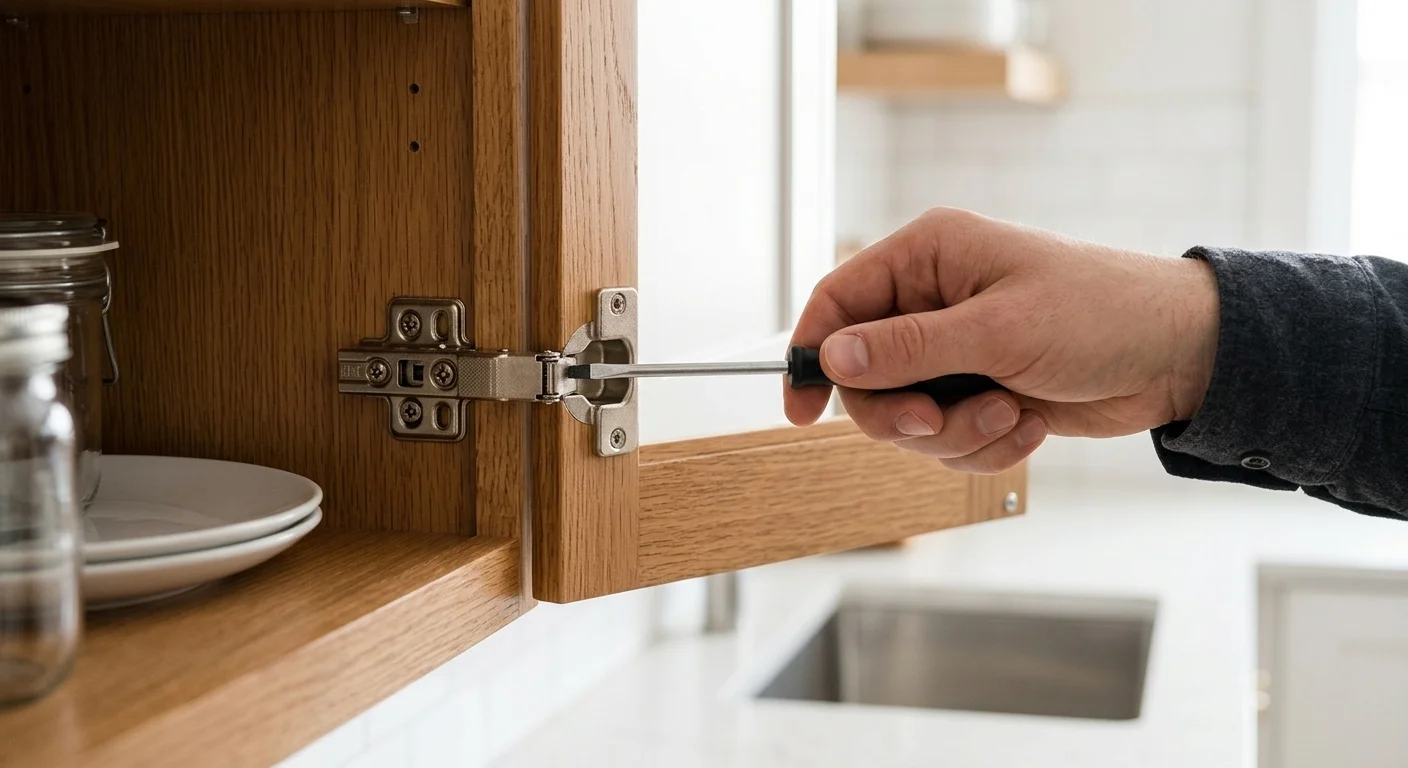
Most modern concealed hinges have adjustment screws that allow small changes without removing the door.
1. Check the hinge screws first
Before changing the alignment, make sure the screws holding the hinge are tight. A loose screw can make a door move again even after you adjust it.
Do not overtighten the screws, especially in particleboard or MDF, because excessive force can damage the material around the screw.
2. Adjust the door from side to side
If two cabinet doors are touching or the gap between them is uneven, the side-to-side adjustment is usually the first place to look.
Turn the appropriate adjustment screw in small increments, then close the door and check the gap again. Small changes are better than making several turns at once because the effect can be surprisingly noticeable.
3. Adjust the door up or down
If the top of one door is higher than the other, check the screws that attach the hinge mounting plate to the cabinet.
Loosen them slightly, reposition the door, and tighten them again while holding the door in the correct position. This is often the simplest answer when learning how to adjust cabinet doors that are sitting at different heights.
4. Move the door forward or backward
Some concealed hinges also allow the door to move slightly toward or away from the cabinet box.
This adjustment is useful when the door sits too far forward, does not sit evenly against neighboring doors, or does not close smoothly. Make small changes and test the door after each adjustment.
How to Adjust a Cabinet Door That Won’t Close
If you are trying to figure out how to adjust a cabinet door that won’t close, do not immediately assume the hinge is the problem.
First, check whether something inside the cabinet is pushing against the door. Then inspect the hinge screws and look for a hinge that appears bent or damaged. If the cabinet door is sitting too far to one side, use the side to side adjustment. If it is sitting too far forward, use the depth adjustment if your hinge provides one.
For doors that still will not close after these adjustments, check whether the cabinet box itself is out of square. A hinge cannot always compensate for a cabinet that has shifted significantly.
What About Self Closing Cabinet Hinges?
Self closing cabinet hinges are designed to pull the door toward the closed position. They are common in kitchens because they help doors remain shut without needing a separate latch.
If a self closing door closes too hard, does not close completely, or sits unevenly, first check the hinge alignment. Depending on the hinge design, there may also be a tension adjustment.
When learning how to adjust self closing hinges, make changes gradually. If the hinge has a tension mechanism, forcing it beyond its intended range can damage the hinge.
Face Frame Cabinet Hinges vs Frameless Cabinets
Face frame cabinet hinges attach to cabinets that have a frame around the front opening. Frameless cabinets have a different construction, so their hinge mounting arrangements can vary. This matters because the adjustment process and available movement can differ between hinge styles. Before turning screws, identify how the hinge is mounted and which screws are actually designed for alignment.
Common Cabinet Hinge Problems
Sometimes adjusting the hinge does not solve the problem. Watch for these signs:
Door keeps moving: A loose mounting screw may need attention.
Uneven gap returns: The hinge or mounting area may be worn or damaged.
Door rubs against the cabinet: The door may need side to side or height adjustment.
Door will not stay closed: Check alignment, cabinet contents, hinge condition, and closing tension.
Screws spin without tightening: The screw hole may be damaged and may require repair rather than another adjustment.
When Should You Replace the Hinge?
Adjustment is appropriate when the hinge is still working correctly but the door position needs correction. Replacement may make more sense if the hinge is bent, cracked, badly worn, or no longer holds the door securely.
It is also important to replace hinges with compatible hardware. The new hinge should match the cabinet door construction and mounting arrangement rather than simply looking similar.
Frequently Asked Questions
Can I adjust cabinet hinges without removing the door?
Yes. Many concealed hinges are specifically designed so you can make alignment adjustments while the door remains attached.
Why is one cabinet door higher than the other?
The mounting position, loose screws, or cabinet movement can cause different door heights. Adjusting the mounting plate is often enough to correct a small difference.
How do I adjust cabinet door hinges?
Start by checking the screws, then identify whether the door needs side-to-side, height, or depth adjustment. Make one small change at a time and test the door.
Should I replace a cabinet hinge instead of adjusting it?
Not necessarily. If the hinge is structurally sound, adjustment is usually worth trying first. Replace it when the hinge is damaged, worn, or no longer holds the door correctly.
Final Thoughts
Learning how to adjust cabinet door hinges is a useful home maintenance skill because many alignment problems are minor and do not require replacing the entire cabinet door.
The key is to diagnose the problem before turning the screws. Check the gaps, tighten loose hardware, make small adjustments, and test the door after each change. If the hinge or cabinet material is damaged, fixing the underlying problem is more important than repeatedly adjusting the hinge.