
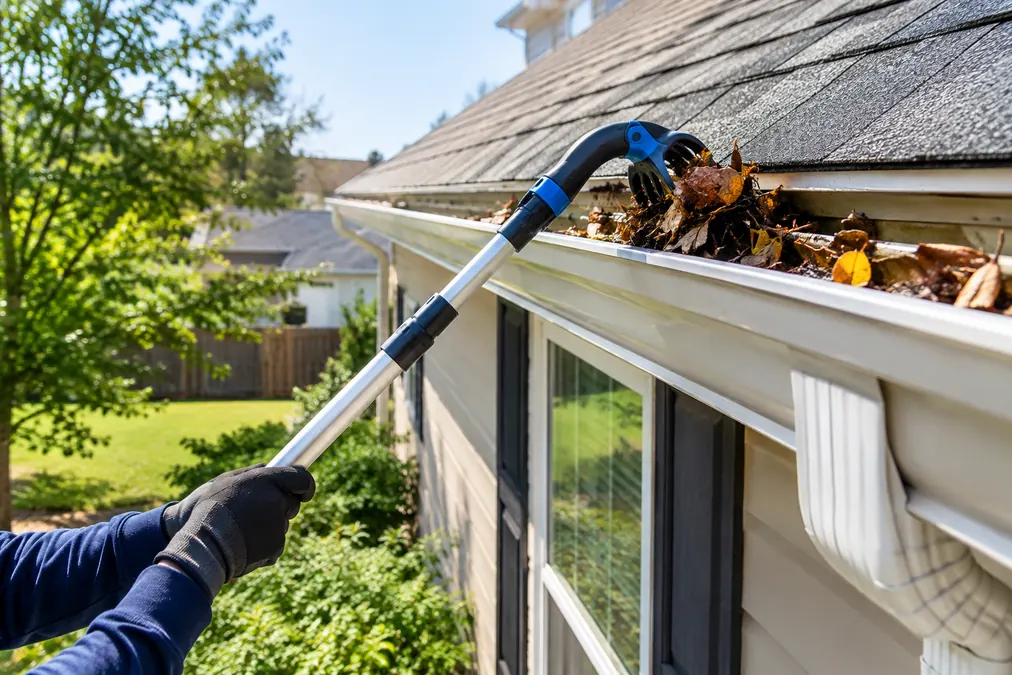

Gutters do not usually look like a difficult part of home maintenance until leaves, dirt, and roof debris start blocking the flow of rainwater. A clogged gutter can overflow during rain, leave dirty water against the exterior wall, or send water toward areas where it can cause problems.
The good news is that how to clean gutters without a ladder is often simpler than it sounds. With the right tools and a little patience, many single story homes can be cleaned from the ground. The important part is not simply removing visible leaves. You also need to check whether water can actually move through the gutter and downspout afterward.
Before You Clean, Check What Is Actually Blocking the Gutter
Start by walking around the house and looking at the gutter from the ground. Check for obvious piles of leaves, twigs, mud, moss, or other debris.
Also look for signs that the problem may be bigger than a simple blockage. Water stains below the gutter, sections that appear to sag, separated joints, or water running behind the gutter can point to drainage or installation problems.
If the gutter is badly damaged, loose, or located where it cannot be safely reached from the ground, cleaning it yourself may not be the right job. Professional help is safer than trying to improvise a way to reach a difficult roof edge.
How to Clean Gutters Without a Ladder
The easiest way to clean gutters from the ground depends on the type of debris and the height of the gutter.
For loose leaves and dry debris, a telescoping gutter cleaning tool can be useful. Some tools have a curved scoop or tongs that allow you to pull material toward the edge of the gutter while standing on the ground.
Another option is a wet or dry vacuum with a suitable gutter attachment. This can work well when the gutter contains loose leaves and small debris, although the attachment needs to be long enough to reach the gutter comfortably.
Work slowly rather than trying to clear everything in one pass. Move along a small section, remove the debris, and then continue to the next section. This makes it easier to notice places where the gutter is holding mud or water.
A useful trick for packed debris
Dry leaves are usually easier to remove than wet, compacted debris. If the material has become stuck together, forcing a tool through it can simply push the blockage farther along the gutter.
In that situation, use a suitable gutter cleaner tool to loosen small sections at a time. Avoid hitting or prying aggressively against the gutter because thin metal or older gutter sections can bend.
Do Not Stop After Removing the Leaves
This is where many quick gutter cleanings fall short.
A gutter can look clean while the downspout is still blocked. Once most of the visible debris has been removed, check the downspout opening from the ground.
If it is accessible from ground level, slowly run water through the gutter using a garden hose. Watch where the water goes. It should travel toward the downspout instead of sitting in the gutter or spilling over the front. A weak flow from the bottom of the downspout can indicate a partial blockage. If water backs up quickly, stop adding water rather than forcing more into the system.
The goal is not to flood the gutter. The goal is to confirm that water has a clear route from the roof edge to the downspout outlet.
Look for Problems Cleaning Cannot Fix
Once the gutter is clear, take another look during or shortly after rainfall if possible. This can reveal problems that are difficult to spot when the gutter is dry.
Watch for these signs:
- Water consistently pools in one section
- Water flows over the front edge during normal rainfall
- Water runs behind the gutter
- A joint leaks repeatedly
- The gutter appears to sag between supports
- Water comes out slowly from a downspout
These symptoms do not always mean the gutter needs another cleaning. Persistent standing water can point to a slope problem. Water running behind the gutter may involve the roof edge or drip edge. Repeated overflow can also be related to gutter capacity, downspout placement, or unusually heavy runoff.
Our guide to Half Round Gutters explains how gutter slope, downspouts, roof runoff, and gutter design work together.
What About Gutter Guards?
Gutter guards can reduce the amount of large debris entering a gutter, but they do not make maintenance unnecessary.
Small seeds, dirt, roof grit, and organic material can collect on or below some types of guards. The surrounding trees and roof design also affect how much maintenance is needed.
If your home has gutter guards, inspect them rather than assuming the system is maintenance free. A guard that is covered with debris may restrict water flow even when the gutter underneath is relatively clean.
How to Maintain Gutters at Home
There is no single cleaning schedule that works for every house. A home surrounded by mature trees may need attention more often than a home with very little vegetation nearby. Instead of relying only on a calendar, pay attention to what happens around your house.
Check gutters after periods of heavy leaf fall and after major storms. Look for new debris, standing water, damaged sections, and changes in how water leaves the downspouts.
Keeping nearby roof areas and trees reasonably clear can also reduce the amount of material that reaches the drainage system. However, do not cut branches or perform roof work simply to make gutter cleaning easier if the job requires unsafe access.
For more general home cleaning guidance, you can also read our guide on How to Deep Clean Carpet at Home Without Damaging It.
When Ground Level Cleaning Is Not Enough
A ground level method is useful for routine debris, but it has limits.
If you cannot see whether the gutter is damaged, the downspout remains blocked after reasonable cleaning, or the gutter is pulling away from the house, the problem may require a closer inspection.
Do not lean out from windows, climb onto roofs, or create an improvised platform to reach a difficult section. Working at height can result in serious injuries, and official safety guidance recommends proper equipment and precautions when ladders are used. The UK Health and Safety Executive provides general ladder safety guidance for anyone who needs to work at height.
For difficult roof lines, multi story homes, damaged gutters, or suspected structural problems, hiring a qualified professional is the more sensible option.
Common Gutter Cleaning Mistakes
Cleaning only the visible leaves
Removing leaves from the front of the gutter does not prove that the downspout is clear. Always check water flow afterward.
Using excessive water pressure
A strong spray may move debris, but aggressive pressure can also scatter dirty water and may damage weak joints or finishes. Controlled water flow is usually enough for testing drainage.
Ignoring standing water
A clean gutter that still holds water may have a slope or drainage problem. Cleaning will not correct an installation issue.
Assuming gutter guards eliminate maintenance
Guards can reduce debris, but they still need inspection and occasional cleaning.
Frequently Asked Questions
How often should gutters be cleaned?
It depends on the amount of debris around the home. Properties near trees may need more frequent attention, while homes with little surrounding vegetation may need less. Inspecting the gutters after major leaf fall is more useful than following one fixed schedule.
What is the easiest way to clean gutters without a ladder?
For many single story homes, a telescoping gutter cleaning tool can remove loose debris while you remain on the ground. A suitable wet or dry vacuum attachment can also help with loose material.
Can I clean gutters with a garden hose?
Yes, a garden hose can be useful for testing water flow and washing smaller amounts of loose debris toward a downspout. It should not be used to force a severe blockage through the system.
Do gutter guards mean I never need to clean my gutters?
No. Gutter guards can reduce the amount of large debris entering the gutter, but dirt, seeds, roof particles, and organic material can still collect and affect drainage.
Why does my gutter overflow even after cleaning?
Overflow can have several causes, including a blocked downspout, poor gutter slope, damaged sections, insufficient capacity, or heavy runoff from the roof. If the problem keeps returning after cleaning, look for the underlying cause instead of repeatedly removing debris.
Final Thoughts
Cleaning gutters is not only about getting leaves out of the channel. A properly maintained system should collect roof water, move it toward the downspout, and discharge it away from the house without repeated overflow.
For many accessible single story gutters, how to clean gutters without a ladder is a practical approach when the debris can be reached safely from the ground. The more important habit is to test the water flow afterward and look for signs of sagging, leaks, standing water, or repeated overflow. These signs can tell you when the problem has moved beyond simple cleaning.